
Home
Re: Unofficial Mechanic Used by Pro-DMs
- Details
- Written by: admin
- Category: Uncategorised
- Hits: 971
Re: Unofficial Mechanic Used by Pro-DMs
Here are my two coppers about the ideas presented in the video above by Bonus Reaction.
1. Mulligan's Luck Rolls - The Luck Roll takes an event that would otherwise be out of the control of the players and assigns it to a die roll. For instance, "on a 15 or higher, a guard comes around the corner and catches you. To me these seem to be a way to get out of making a decision. If you want something to happen, just declare it so. Make it rain. Make the guard come around the corner. As the DM, you are everything but the players. You could also build these possible outcomes into rolls the players are making. With the example of a guard turning the corner, that could be what it means to roll a Nat 1 on an attempt to pick a lock or sneak down a hallway.
2. Mercer's Fading Spirit – In a sentence, resurrection becomes more difficult with each death. I haven’t had to deal with this in any of my games so far. The idea sounds solid. It should get harder to come back. The gods of death don’t like cheaters. The character’s immortal soul might be tired of repeatedly dying. Death ceases to be a threat when it becomes another way to take a long rest.
Other ways you might handle it: A character gets to fail three death saves period. Dying causes permanent loss of a point of Constitution. Send the dying character to a scene with their deity and/or the agent of death so the character can make their case to return.
I also recommend death saves happening behind the screen. That keeps the tension high. The other PCs don’t know how close death actually is, so they don’t put off saving their party member.
3. Mulligan's Rolling with Emphasis – For a particularly important roll, roll two d20s and keep the die that is farthest from 10. A d20 has a flat distribution with every result having an equal chance of appearing. With advantage, the distribution is weighted to high results. With an Emphasis roll you have a U-shaped distribution, more high and low rolls and few middling rolls. The tricky bit with this mechanism is that it frequently ties (both dice are the same distance from 10), I recommend giving PCs the higher number.
I haven’t had a chance to use this yet, but I want to try it. Seems like it could be fun for a special saving throw or attack. The party has a villain on the ropes, one hit could make all the difference! Or maybe the aura of a chaos elemental causes extreme outcomes.
Here’s what it looks like assuming you reroll ties:
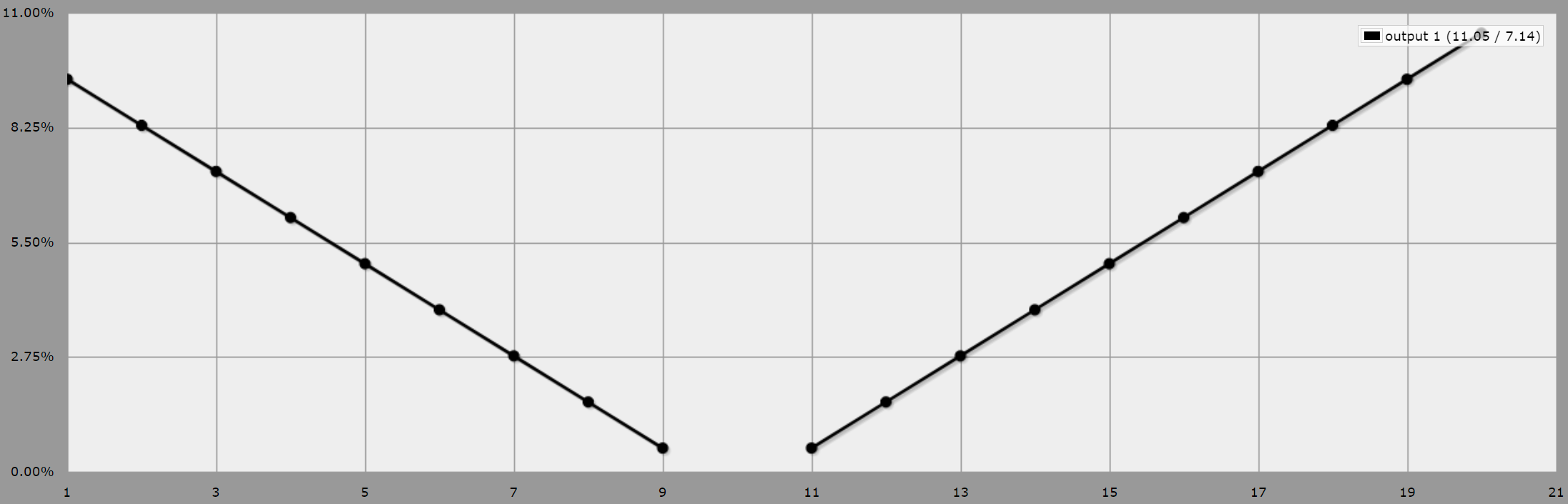
Another way to do this is to flip a coin: heads are 20, tails are 1. Crits and fumbles galore.
3. Mercer's Desperate Measures – When your character is Bloodied, you can give yourself a failed Death Save to do something special, like Dash or Disengage, or reroll an attack. This sounds like fun. The mighty knight takes a devastating blow from the demon. He knows he needs distance ASAP, so he “spends” a Death Save to Disengage. A sorceress, through her bloody vision sees that her spell is about to fail, exerts her will to reroll her spell. Much of the time checking off a Death Save isn’t going to mean the character dies. To make this rule have the gravity it should, make removing a failed Death Save require more than a Healer’s Kit and a nap.
4. The Chris Perkins Critical Hit – The official crit rules for 5.x are sad. You could roll that natural 20 and roll minimum damage. Rolling snake eyes on a Nat 20 would be tragic. This house rule says that on a Nat 20, you automatically get the full damage of your weapon, add your flat modifiers and then roll your weapon damage. So 2d6+2 would be 12 + 2 + 2d6 (average of 7). After that you can roll sneak attack and hunter’s mark as needed.
The Perkins crit expresses that you hit hard and gives you the satisfaction of still getting to roll for some extra damage. This is what I use in my current game.
5. Alternative Crit Hit Rules, Gritty and Brutal – This option adds some sort of complication to a critical hit like being knocked prone, pushing them or disarming them. These could be fun if the players understand they are going to suffer these effects as well and potentially, often. A fun way to do this might be to decide it on a case-by-case basis depending on what is happening. The GM and players can think about what makes sense or what is most fun. Keep in mind some of the effects above can dramatically change the battle.
6. Nat 20s and 1s on Skill Checks – Officially in 5E rolling a 20 or 1 on a skill check is nothing special… add your modifier and move on. B. Dave Walters does what I suspect most DMs do and have a 20 be an automatic success and a 1 be an automatic failure, ignoring DC and modifier. This ensures there is always some chance for success or failure, even if it's only 5%. 20s and 1s feel special, so let them be. HOWEVER, skill checks are not magic, and they are not powerful class features. The DM needs to decide if the player makes the roll at all. If the task is too difficult, don't allow a roll. If it's too easy and there's nothing at stake, don't bother rolling. Don't let a player roll to convince the king to give the bard his kingdom. Just say no. If you allow a roll, just keep in mind what a skill check is and is not able to do.
Let a 20 be the best possible, reasonable outcome. In the case of the king, the best outcome is that the king gets a good laugh and doesn't throw the bard in the oubliette. I recommend letting the player narrate the result of a 20 (including critical hits). It's also an opportunity to narrate the PC doing something with incredible style, or to grant them some especially good result.
When thinking about a natural 1, resist the urge to make it certain death or some other great catastrophe. PCs are pretty competent people. They don't just suddenly become horrifically or comically incompetent. If the rogue rolls a 1 to pick the lock, he breaks his tools or jams the lock shut so now they need to go to Plan B. B stands for Barbarian Breaking down the door. Sometimes it might be fun to let a Nat 1 be something hilarious. Just don't overdo it. You might make the player feel badly or ruin the serious mood you’ve established.
7. Countdown Timers - The first time I saw Countdown Timers was Blades in the Dark (Progress Clocks), though I suspect they've been around much longer, formally or informally. I love these as a way to add a bit of time pressure or visualizing one side of the conflict's progress toward some goal. Sprinkle these into your campaign at all levels of the game. The most obvious use is at the tactical, moment-to-moment level. Score four successes toward your infiltration to reach the Gibson server room. Or each time you make an alchemy check, fill a section of the clock when you fail, when it's full... your lab explodes! For a strategic use, set a timer for the archmage completing her transformation into a lich. Increment the clock each time the players go on a side quest or work on some downtime project. Let the players design a spell over several sessions. Fill a slice of the pie for each successful roll of them doing research and experimentation.
Level 1 Characters for Nimble
- Details
- Written by: admin
- Category: Uncategorised
- Hits: 1319
Here's one character, of each class at first level for Nimble:
Download Changeling_Shadowmancer
Matrixed Attributes
- Details
- Written by: admin
- Category: Uncategorised
- Hits: 2107
Matrixed Attributes
Some Role Playing Games (RPGs) used something I like to call Matrixed Attributes (XA1). This categorizes Player Character (PC) attributes in two dimensions, creating a grid or matrix. One example of this is the 5th edition of World of Darkness (WoD). These dimensions are hidden but are Physical, Social and Mental going one way, and Force, Control and Endure the other. WoD has this matrix structure to its attributes, but only the Physical, Social and Mental dimension are explictly named. I'm going to call that dimension Aspect. The other, I will label Method (Force, Control, Endure).
Aspect - What domain of activity is it?
Method - How is the character trying to affect the narrative?
This is the matrix for WoD 5e:
| Physical | Social | Mental | |
| Force | Strength | Manipulation | Intelligence |
| Control | Dexterity | Charisma | Wits |
| Endure | Stamina | Composure | Resolve |
For Dungeons and Dragons
Here's the matrix I'd use for D&D and its variants.
| Force d12 | Control d10 | Endure d8 | |
| Body d12 | Strength | Dexterity | Constitution |
| Soul d10 | Charisma | Intelligence | Wisdom |
In this model, you don't have a flat bonus to add to your d20. Instead, you roll and sum the dice indicated by each dimension. For an effort using Physical/Force, roll 2d12 (Strength). This gives you a range of 2 to 24 and an average of 13. Soul/Endurance (Wisdom) would be d8 + d10 with a range of 2 to 18 and an average of 10. The averages in the strongest and weakest cases are close to what your might get for a character with a +3 and +0 bonus respectively. That's pretty close to what a first level character might have under the d20 + Modifier model.
- With this model you can't roll a natural 1 or natural 20. You might make rolling all 1s the new fumble, and critical success could be rolling double the AC/DC. In a game using this, fumbles will be very rare. Feel free to make them particularly vicious.
- Some ACs and DCs will be out of reach for some characters some of the time. The example character above can't roll above 18 for "Wisdom". That reinforces that some characters will do better than others at some rolls.
- Rolls are going to be closer to average. That might be good for a more grounded, down to earth game.
- You can still use the Proficiency Bonus as usual, or you can use the optional Proficiency Die. That would work very well with the idea of a fumble being rolling all 1s.
- You'll need more dice to use this, that might be fun though.
- Speaking of more dice, grab some of the odd numbered dice so you can cover the gaps between dice. Instead of going from d8 to d10, you can have d9. d9s exist!
- I haven't thought of how attribute increases would play into this yet.
1 I'm using X for matrixed in the same way that the word pixel (picture grid element) does. Think X by Y.